
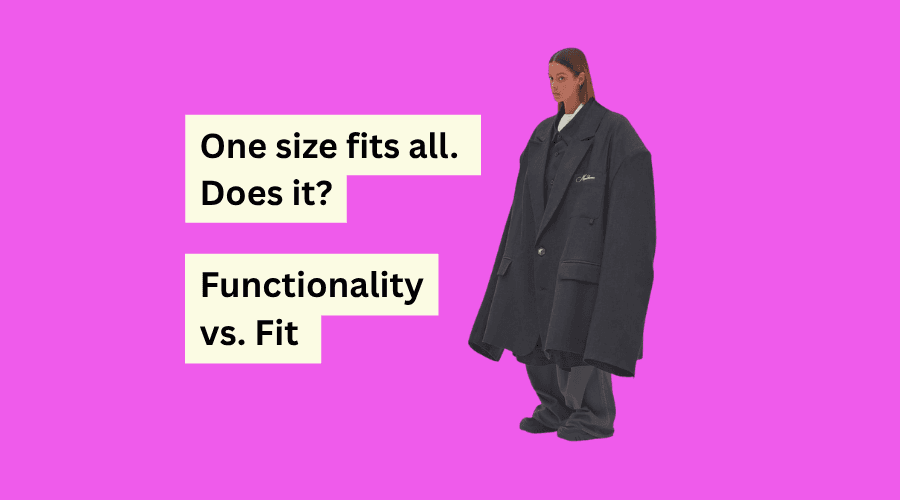
Imagine a company decided to simplify everything by creating only one suit size.
One jacket. One pair of trousers. One standard fit for everyone. Technically, everyone could wear it.
For some people, the sleeves would be too long. For others, the trousers would sit awkwardly. Some would need to roll the cuffs, tighten the waist, pull at the shoulders, or constantly adjust the fabric just to move comfortably through the day.
But the answer would always be the same: “The suit works. You can wear it.”
And that would be true. It would be functional.
But FUNCTIONALITY and FIT are not the same thing.
There is a profound difference between something people can use and something designed to work for them.
In a one-size-fits-all system, everyone adapts differently. Some barely notice the compromise. Others spend the entire day adjusting themselves to make the system work.
Not enough to completely stop functioning. Just enough to create constant friction, to continuously adapt to barriers.
A rolled sleeve here. A restricted movement there. A slight discomfort while sitting.
A subtle awareness that the system was not really built around your proportions, your reality, your way of moving through the world.
None of these issues seem dramatic in isolation. And that is precisely why they are so often ignored. But friction accumulates.
The person wearing the well-fitting version of the suit spends their energy on the meeting, the conversation, the work, the performance itself.
The person constantly adjusting the suit spends part of their energy managing the suit in addition to everything else. And over time, this changes the experience entirely.
This dynamic exists far beyond clothing.
Many products, systems, services, workplaces, technologies, and environments operate exactly like one-size-fits-all suits. They technically work for almost everyone, but they fit some people far more naturally than others.
The people closest to the “default size” move through the system with less resistance. The others learn to compensate.
Importantly, most adaptation becomes invisible over time.
People become so used to adjusting themselves that they stop questioning the design itself. They assume discomfort is normal. They become highly skilled at compensating, workaround thinking, self-correction, and silent adaptation.
From the outside, everything still appears functional. But hidden beneath that functionality is a constant pressure to work around barriers.
And because adaptation is often silent, the gap is misunderstood.
We tend to celebrate resilience without asking what made resilience necessary in the first place.
We praise people for learning how to operate inside poorly fitted systems instead of asking whether the system itself could be designed differently.
This is why “functional” is a dangerous benchmark. Functional only asks: “Can people still operate?”
Fit asks a far more important question: “How much adaptation does the system require from them?”
That difference between Functional and Fit changes everything.
The most effective and performing systems are not necessarily the ones that force people to adapt best. They are the ones designed to reduce unnecessary adaptation in the first place.
The starting point is recognizing that human realities are not all identical - and that good design acknowledges this instead of pretending otherwise.
A one-size-fits-all suit may technically work for everyone. But it will never fit everyone in the same way – putting barriers to some, thus preventing the whole from progressing at a higher speed.
In society that essentially means slowing down evolution. In business it means slowing down growth. It’s a limitation of potential.
When we talk about The Women Growth Gap™ this is what we mean: there is huge growth potential that is limited by the lack of solutions which truly fit women’s realities.
Image credits: Cedo AI farm/ Pinterest.