
Celebrating women on International Women’s Day is important. Developing women for leadership representation is great. Promoting women is even better.
But what if all these gestures and actions, great and well-intended as they are, still miss something fundamental? What if, by simply encouraging women to just do more, we actually overlook the pressures that shape their daily lives and even add to that?
Because equality is not only about representation. It is about ultimately creating better lives for women and men.
When we talk about gender equality, we often focus on the big structural issues: laws, representation, pay gaps, cultural narratives. These dimensions are essential - but they explain where inequality exists, not how it is lived.
At WeWill, we look at the issue through a different lens. We focus on pressure as the translation layer between systems and lived reality. It’s how social expectations become daily behaviour, trade-offs, and decisions.
Understanding these pressures is not only socially relevant. It is economically relevant. Because pressures shape how people live, choose, buy, and respond to products, services, and brands.
In-depth research for real understanding
To understand women’s pressures in depth, we interviewed psychologists and professional coaches across the world. Why them and not just run consumer researches or just ask AI?
Because these are often the only environments where women feel safe enough to speak openly about what they truly experience without fear of judgement or social consequences.
Through these conversations, a clear pattern emerged. Across cultures, professions, and life stages, many women experience a shared architecture of pressures.
We identified five key pressure categories that repeatedly shape women’s lives.
Five Categories of Pressures
A. Core Individual & Identity Pressures
These pressures relate to how women define themselves and the standards they hold themselves to. Many women operate with extremely high expectations - striving to perform, improve, and prove their worth. This can lead to perfectionism, self-doubt, and a constant dialogue about whether they are doing enough, being enough, or taking up too much space.
B. Relational & Care-Related Pressures
These pressures emerge from relationships and social roles. Women are often expected to care, accommodate, and maintain harmony – at home, at work, and in social circles. This often translates into prioritising others’ needs, carrying invisible emotional labor and unpaid domestic labour, and feeling guilt when focusing on personal goals, rest, or ambition.
C. Load, Capacity & Sustainability Pressures
These pressures relate to the sheer volume of responsibilities many women carry. Women often manage multiple roles simultaneously, many unpaid and unrecognized, while maintaining high levels of reliability and performance. Over time, this can lead to mental and emotional overload, postponed self-care, and a tendency to keep functioning even when energy and resources are depleted.
D. Social, Cultural & Normative Pressures
These pressures come from societal expectations about what a “good woman” should be. Cultural narratives around gender roles, behavior, ambition, and motherhood influence how women present themselves and the choices they feel comfortable making. These norms often shape career decisions, leadership expression, and personal life choices.
E. Visibility, Comparison & Body-Related Pressures
In a highly visible and digital world, women face constant comparison and evaluation - particularly around appearance, age, success, and lifestyle. Social media amplifies these dynamics, creating powerful and often false narratives about beauty, aging, and achievement that can shape confidence, identity, and how women relate to brands and products.
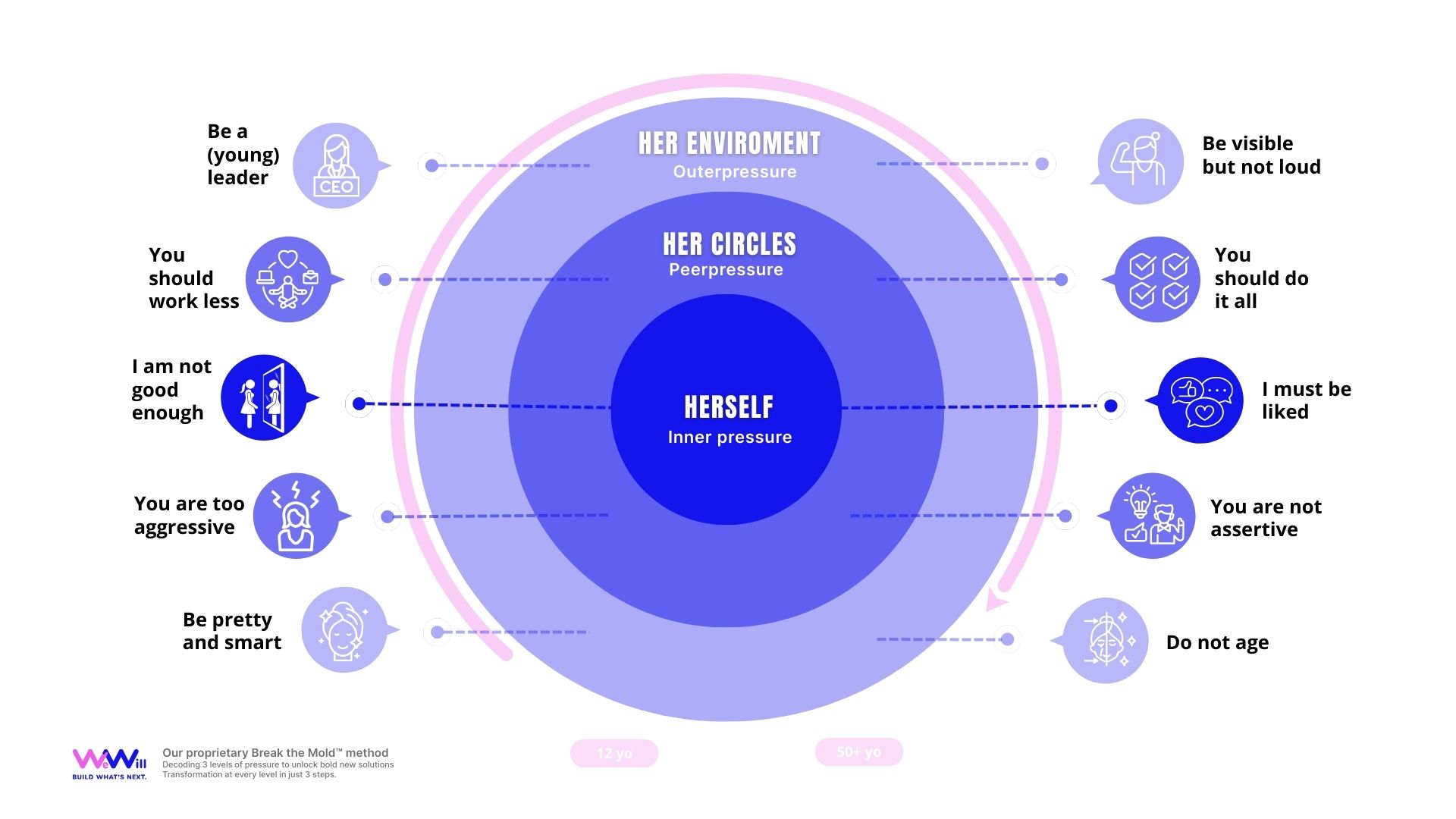
Three Levels of Pressure
These pressures operate simultaneously on three levels.
Inner pressure - Internal expectations and identity standards.
Peer pressure - Expectations transmitted through relationships and comparison.
Societal pressure - Norms and systems that shape behaviour and opportunity.
Each level reinforces the others, creating a complex dynamic that influences how women operate - as professionals, consumers, and individuals.
Why This Matters for Business
For businesses, understanding these pressures opens an enormous opportunity.
Because when products, services, and communication acknowledge real pressures instead of ignoring them, solutions become more relevant, innovation more meaningful and brands more trusted. Instead of adding to the pressure, businesses can design solutions that release pressure. And that creates value for everyone.
A New Way to Celebrate Women
If we truly want to celebrate women - not only on International Women’s Day, but every day the goal should be to release the pressure and enable women to truly thrive.
By understanding the pressures that shape women’s lives, we open the door to smarter business decisions, better solutions, and more inclusive growth. And that benefits the society as a whole.